The world has become more complex each day we wake up. The changes happening around the globe have also started to create a gap and exclusivity between people. Cyber security is one of many exclusivity that exist during this globality era, and a gap that we need to close and tighten to build a more secure society.
Security and usability are usually considered important as people build the technology of cyber security, but accessibility always comes as a later consideration (Renaud & Coles-Kemp, 2022). This unavailability created the mindset that cyber security is not a primary need, and can be replaced by something else.
Cyber security is expensive. That fact cannot be separated by no matter how much awareness of cyber threats power to ruin someone’s data and privacy. Some organizations are also not ready to discuss either cyber security or the importance of protecting their data. Some of ACSI’s engineers said, “Most people are afraid when they hear about penetration tests. They thought it was a harmful thing to do.”
Accessible and cyber security.
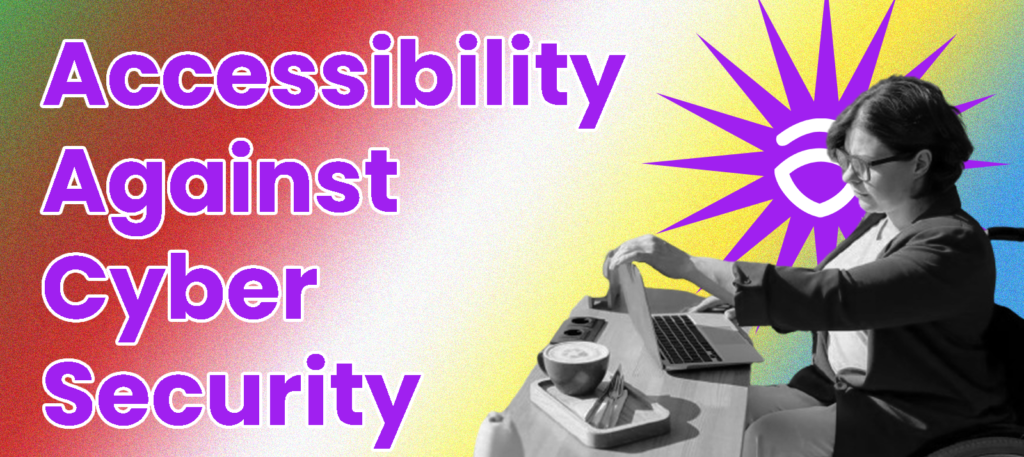
Spreading awareness is the least thing that cyber security organizations can do to create a better society where cyber security is more than an alien concept. But, awareness is not enough to create a world where cyber security is accessible to everyone. Accessibility in cyber security is not only about money and the power to have access to protection but also a guarantee that people with disabilities can work and operate in the cyber security field.
Quoted to WebAIM research:
"Only 3% of websites in 2022 were accessible to people with disabilities. This problem might be solved if there are more people with disabilities–who understand the importance of accessibility–work in cyber related organizations."
Disabilities are not only about physical limitations: those who cannot see some colors, or those who need better visual elements, but mental disabilities also play a part in here. Mental disabilities such as ADHD, autism, and more require a better environment to work where they do not feel judged.
Cyber security requires more innovative talent and an environment that is accepting of people with diverse skills–who are also limited by some disabilities. People with disabilities should be encouraged to join cyber security teams, instead of being pushed away.
Infosecurity Magazine interviewed someone from Twitter who is a neurodivergent CISO, this person claimed that someone’s brain with dyslexia and dyspraxia thinks differently and always works out of the box to provide a unique solution. He said the following:
“As someone living with dyslexia and dyspraxia, I identified that my brain worked differently and was hungry for the challenges and problems cyber presents on a daily basis. I became very successful in this field”
Although the case from one person to another person is obviously different, this could be proof that people with disabilities should never be seen as a hindrance during cyber security projects.
Accessibility and money.
Money is always part of the problem. Cyber security protects organizations’ data from being stolen or taken as a ransom. It also overviews threats for 24 hours non-stop. That sounds like a promising service to have, and an essential need during the technological advance era.
But what about those organizations, businesses, or people who do not have the money to access cyber security services? Whose responsibility is it to help guard their data and make sure that they can still run their businesses? It is worth noting, that small and medium businesses are still part of the country’s economy. Their contribution to the country’s economy makes it worth guaranteeing their safety.
Jackson Henry, a consultant from Australia once said that most of the time, small businesses have no idea where to start, combined with the lack of money and resources compared to bigger businesses, and it becomes a combination that prevents them from having a good cyber security protection.
However, this topic is a difficult topic to discuss because we all need to admit that companies that offer cyber security services are also profit-oriented. They cannot just simply give free services away, or invest in something that returns in low amounts or questionable returns.
It is not only cyber security consultants’ responsibility, but also the government, academicians, and cyber security enthusiasts to sit together and discuss the solution to this problem. But most importantly, a discussion would not bring this issue further if there is no action taken. A proper action needs to be followed after the discussion phase is done.
Read our other works:
• Indonesia Upcoming 2024 Election Cyber Problems
• What is Printer Hacking? Get to Know Printer Hacking and How to Protect Your Company
• Vigilant of Cyber Threats on Holiday Season
References:
- Renaud, K., & Coles-Kemp, L. (2022). Accessible and inclusive cyber security: a nuanced and complex challenge. SN Computer Science, 3(5), 346.
- https://webaim.org/projects/million/
- https://www.infosecurity-magazine.com/magazine-features/diversifying-cyber-neuro-disability/
- https://www.mastercard.com/news/ap/en/newsroom/press-releases/en/2023/new-data-reveals-up-to-309-000-australian-small-businesses-say-they-ve-been-targeted-by-cyberattacks-yet-many-are-forced-to-cut-cybersecurity-costs/